



In late October, a Climate Group delegation led by CEO Helen Clarkson and Nehmat Kaur, Director of the Under2 Coalition and Subnational Governments - travelled to South Korea to attend the Chungnam International Conference on Decarbonisation. Head of Policy and Advocacy, Andrew Forth, shares his reflections on the trends, challenges and highlights from the annual conference.
Climate leadership in South Korea – the importance of local leadership
One of the highlights of 2024 for the Under2 Coalition has been the growing awareness from policymakers about the breadth and depth of the work being undertaken by Under2 members around the world.
Hosted by the Under 2 Coalition Asia co-chair Chungnam Province, the International Conference on Decarbonisation is a striking example of how subnational governments are driving the climate agenda forward by taking action to address climate challenges in their regions and beyond.
Global challenges, local solutions
One of the focuses this year was methane. The conference included a signing ceremony to celebrate Chungnam joining the Subnational Methane Action Coalition (SMAC). Methane is a particularly good example of the need for concerted multi-level action to address the huge variety of methane emissions sources. In addition to views from Chungnam, it was great to hear how subnational governments including Baja California Sur in Mexico were pressing their national governments to raise the level of ambition on methane.
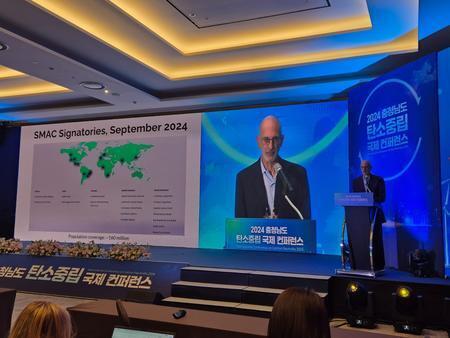
SMAC presentation at the Conference on Carbon Neutrality
The theme of multi-level governance is one which is close to the heart of Climate Group and the Under2 Coalition. During our time in Korea we met with politicians from across the political spectrum and we were pleased to be joined at the Chungnam Conference by Urszula Kasperek, Head of CHAMP National Engagement at C40 Cities who moderated an international discussion on multi-level governance in the climate space which featured contributions from China, the Philippines, Quebec, Catalonia, Australia and Korea.
The CHAMP (Coalition For High Ambition Multilevel Partnerships) initiative is a key priority in Korea for Climate Group and in addition to the public discission at the conference, several of our meetings with Korean stakeholders focused on the role of subnational governments in the Korean climate debate.
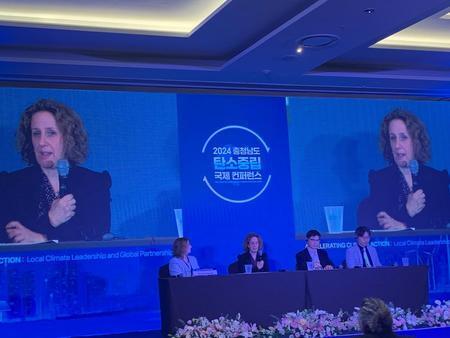
CHAMP Panel at International Conference on Carbon Neutrality
We were particularly grateful to have the chance to meet with representatives from both of South Korea’s main political parties at meetings in Chungnam and at the National Assembly in Seoul. We also met with Ambassador Keeyong Chung, South Korea’s Climate Ambassador and Deputy Minister for Climate Change to discuss Korea’s plans for COPs 29 & 30 and the NDC.
“This was an incredible opportunity to witness this scale of subnational leadership in Chungnam for the 2024 International Conference on Net Zero and Transition," says Nehmat Kaur, Director of Under2 Coalition and Subnational Governments.
“The event truly embodied a sense of global cooperation with representation from national and subnational governments joining the conference from around the world. We also heard about fantastic progress within the Republic of Korea on multilevel action under the country's endorsement of CHAMP.”
The leadership on show in Chungnam, as well as that demonstrated by key national agencies, on how they are working together towards greater NDC ambition in Korea is exemplary.”
Renewables continue to dominate policy discussions
South Korea is regularly ranked by RE100 members as one of the most challenging markets in which to buy renewable electricity. This issue came up repeatedly in our conversations with the media and policy makers and it is clearly going to be a major political theme in the coming months.
The transition away from fossil fuels is also going to be a major challenge for Korea’s steel industry. With steel accounting for 40% of Korea’s industrial emissions and undermining many of Korea’s most important export sectors such as automotive and shipbuilding, the sector has an outsize place the Korean economy – but progress towards decarbonization is proving slow with growing concerns about Korea’s ability to match the speed and scale of progress being seen in other markets.
We are still miles away from net zero targets however what we have witnessed in Chungnam is promising. Meeting challenges with solutions, addressing climate change with bold and ambitious climate action is key.