



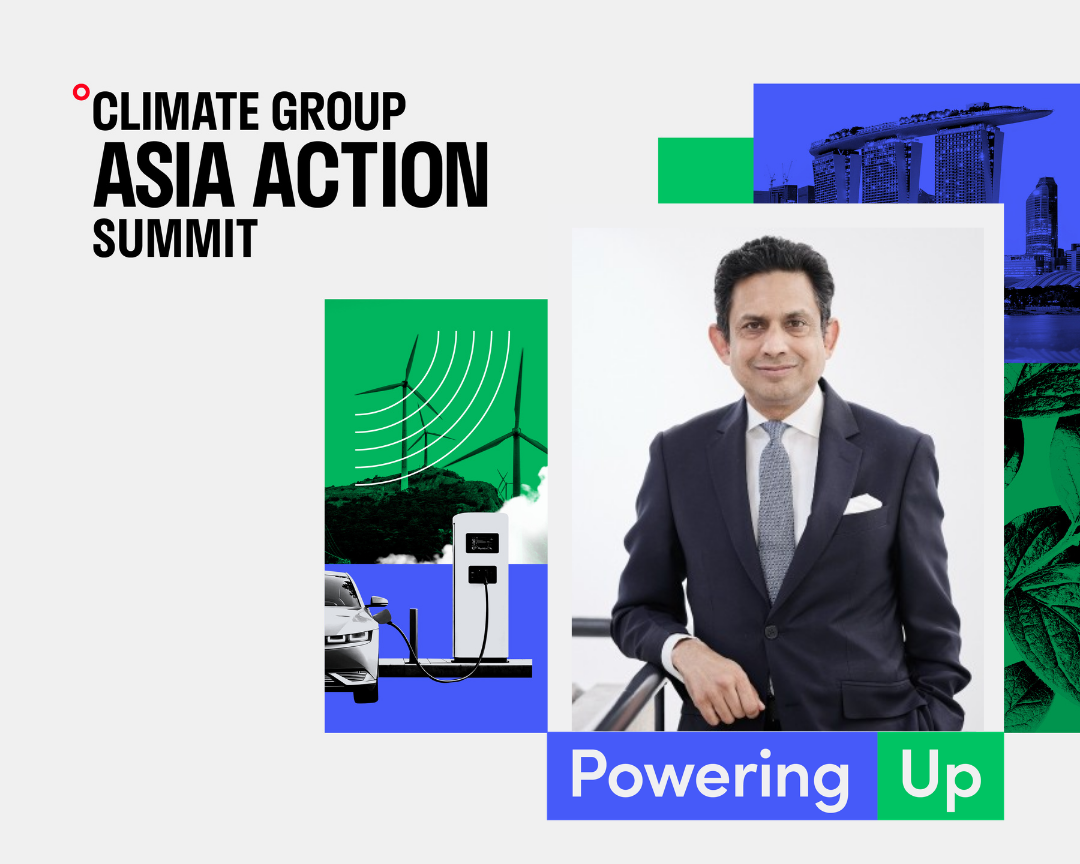
Battery swapping, collapsing cost curves and the rise of innovation in the Global South. This interview with Uday Khemka, Vice Chairman of the SUN Group of companies, frames how business model innovation, affordability and AI-driven energy systems are reshaping mobility and accelerating the EV transition across Asia.
Could you tell us a bit more about Sun Mobility's business model? And the kind of innovations that you've seen across the years of you building up Sun Mobility and the shifts that have led to this moment in electric vehicle uptake in India.
I think we have a very exciting inflection moment in the Asian EV market that is the result of large techno-commercial forces: the collapse of solar prices, the collapse of EV prices, battery prices generally, but also the innovation of new business models and technologies. And, you know, we're so used to thinking of technologies coming from the North to the Global South. It's super exciting now that we have new deep-tech companies emerging from the Global South that are applicable to the Global South, and even perhaps applicable to the Global North in ways that are totally differentiated.
One of those companies is Sun Mobility, which is a company in our portfolio that we're very excited about. The foundation of this is a partnership with India’s EV luminary and technological pioneer, Chetan Maini. And as you may recollect, Chetan returned from the US in the ’90s to create an EV business for the world, which he succeeded in doing. In the early 2000s and through the 2010s, he built Reva, the Reva car company, into one of the first global EV manufacturers (OEMs), and sold his vehicles in 24 markets around the world.
Sun Group has partnered with him and created Sun Mobility, which is based on a very different vision from the traditional model of fixed electric vehicles. The fundamental challenge that all EV markets face is charge time, range anxiety, and the ubiquity of infrastructure. But in developing countries, we have an extra dimension which becomes absolutely mission-critical: affordability. If you are 10 or 20% more expensive, you have hardly any market. Whereas if you are at or below parity in mass markets like India, you have an almost infinite market.
So Chetan put himself to thinking about how you could do that, and he realised that the only way to create a cheaper EV proposition than ICE (Internal Combustion Engine) was to take the most expensive component of the system—the battery—out of the vehicle, and lease or sell the vehicle without a battery. Now, the effect of this was to create a value proposition for the end customer that is cheaper than a petroleum, diesel, or gas-powered vehicle—and cheaper to operate, of course, because of electricity per kilometer, and very few repairs. As those of you who know the EV sector know, there are very few moving parts.
By taking the battery out, we could supply electrons as an infrastructure company and benefit from the lower cost per kilometer to amortise our capex spend, achieve very good unit economics, and scale efficiently. This model has grown into the modern business of Sun Mobility, which is a Singapore-based company, but whose largest market is in India.
I want to take a minute on that. India is by far the biggest micromobility market in the world. It’s not the only one—Indonesia is important, as are Thailand, Vietnam, and Malaysia—but India is the largest. We have 200 million vehicles in the fleet, and 26 million new vehicles every year. It’s huge. And so, if you can create a customer proposition that’s cheaper than existing alternatives, that can really take you to massive scale—up to a point where you can actually affect GHG emissions coming from the transportation sector.
I would like you to continue, but also if I can add a very small question to your reflections. It seems like there are many learnings that are coming out of the Indian market, and would you say that that's the case? Because some of what you mentioned seem like learnings to me that can be replicated across the Asian market. So, is that something that you see?
There’s no questions at all. We have launched in the Philippines; we did a pilot with Shell and have now launched with other local partners, and the microeconomics in the Philippines are even better than India.
Similarly, we’ve considered other Asian markets, and the economics are almost the same, as long as you don’t have highly subsidised petroleum markets, in which case no EV is going to work. But compared to fixed electric, this solution is much cheaper.
We’ve also launched in Africa, where again the microeconomics are as good as India. We did a pilot in Peru with Siemens Energy, and the numbers came back wonderfully. So, this is an entirely globalisable model, and we are globalising it.
This is an extremely exciting era, when models created in emerging markets can spread across emerging markets, and are very tuned to the sensitivities and microeconomic realities of Asian economies.
Let me give you some more examples. When we launched Sun Mobility, we chose to focus on shared mobility. In India, only 15% of commuter miles are in personally owned four-wheel vehicles. 45% are two- and three-wheel vehicles, and 40% are through municipal buses.
Therefore, our products are geared towards these formats—two- and three-wheelers through a self-swap model, and trucks and buses through robotic solutions. These are all shared, high-utilisation applications. You see the same pattern across Asia, where many people commute using smaller vehicles or buses, unlike in places like Houston where most people drive four-wheel vehicles. This makes the model highly replicable across markets.
A third point: the core driver for electrification of mobility in India, as with the solar industry, is the fact that the country imports large amounts of fossil fuels. Petroleum imports have historically been about 10 times the cost of coal imports.
The government realised that you could capture energy through high solar radiation and flow those electrons into transportation. This is exactly what has happened in China at massive scale, and in India we saw the same potential. That potential is now playing out because of the enormous burden of petroleum imports on the economy.
Some Asian countries produce fossil fuels, but many do not, so the same dynamics apply across the region.
Another parallel is pollution. India has 13 or 14 of the 20 most polluted cities in the world. Much of this comes from small vehicles, two-stroke engines, and trucks. Electrification of transport can eliminate a large portion of this pollution, potentially saving millions of lives from diseases like lung cancer, bronchitis, and asthma. Many Asian cities face similar challenges, making these drivers highly replicable.
I’ll add one more point on petroleum imports. Look at what’s happening in the Gulf: it’s unfortunate. The immediate impact is higher petroleum costs, but it’s not just about cost; it’s also about availability.
This highlights how energy-insecure many countries are, even as they aim to reclaim their historical economic strength and lift billions out of poverty. All of that requires energy. Solar plus storage plus EVs enable countries to build self-reliant energy systems at scale.
So yes, it’s incredibly exciting, and the lessons from battery swapping apply across Asia.
Let me give you another example. Infrastructure availability is very limited, especially for low-income populations. Imagine living in a low-income housing block: where is your charger? Even if there’s one, how do 50 drivers share it?
With battery swapping, you drive in, swap in 30 seconds, and leave. It requires minimal engineering and can even repurpose existing petrol stations. Compare that to the cost, complexity, and energy loss associated with fast charging, something developing countries can’t easily afford.
Another issue is heat. In countries like India, high temperatures degrade battery life quickly, especially when vehicles are left in the sun. With swapping, batteries are centrally managed, thermally controlled, and maintained to extend their full lifecycle. This fundamentally improves the economics.
There are many lessons here, but the key point is affordability. That’s what enables delivery drivers, taxi drivers, and gig workers to earn more, support their families, and access education and healthcare.
We’ve been able to double vehicle utilisation while reducing costs. It’s not just cheaper than fixed electric—it’s cheaper than petrol or diesel. That’s why it works.
I would add one final point: you can’t simply transplant models into the Global South. Many companies have tried and failed. You need cost structures and thinking that are rooted in the realities of these markets.
Business models must enable ubiquitous usage. For example, a vehicle designed for performance enhancement through battery storage won’t work if there isn’t enough usage density to support the economics of swapping infrastructure.
A petrol station serves everyone. Similarly, Sun Mobility integrates with multiple OEMs—two-wheelers, three-wheelers, even four-wheelers—across different brands and formats. The system is flexible and software-driven. That universality is critical.
The good news is that Asia now has the engineering talent to build these solutions. India, for example, has some of the best software and AI engineers in the world, at a fraction of the cost of the West.
That means the capital required to build these systems is much lower. We do hope the West catches up, but we’re moving toward a world where the Global South leads in many areas of technology.
And we look forward to working with partners in the North who want to benefit from these innovations.
I say that partly as a joke, but there’s some truth in it.
On that note, taking the conversation forward on something you mentioned: AI. Can we talk a bit about how AI can transform energy management and industrial efficiency?
So, I’m going to take off my hat as Vice Chair of the Sun Group and put on my hat as Managing Trustee of the Nand & Jeet Khemka Foundation. It is one of the oldest foundations out of India focused on the energy transition.
For the past four years, we have been working globally with AI companies, university centers, research institutions, and startups on one side, and large domain companies and chambers of commerce on the other, to explore AI applications for climate change.
The question really needs to be reversed. In what area can AI not deliver a massive, discontinuous shift in efficiency, cost reduction, new business models, new materials, and increased speed and velocity of revenue generation?
Through the Green AI Learning Initiative, which we set up about a year and a half ago, we held a major summit last year with University College London and several global partners, including the Alan Turing Institute. We brought together 200 experts from 115 institutions worldwide to examine this very question.
We were surprised by the sheer number of practical, value-creating applications. These included power generation, grid optimisation, demand management, and resilience integration into the grid. This also extends to storage integration from distributed sources, including EVs but not limited to them.
There are equally strong applications in the built environment. The way buildings are constructed, how material supply chains are organised, and how cities are designed can all see significant cost reductions and economic benefits. The same applies across sectors such as shipping, aviation, and horizontal areas like supply chain and value chain integration, as well as new materials innovation.
Coming to EVs, I agree with your earlier points, but it helps to look at this from another perspective. While there may be opportunities for green hydrogen in mobility, the vast majority of the sector will be electrified.
Once you accept that, you begin to see that the vehicle is effectively part of the grid. These assets are constantly being charged, storing energy, and potentially feeding energy back into the system. This creates a highly complex ecosystem.
AI enables the integration of distributed energy sources, both generation and storage, into a resilient grid framework. This, in turn, unlocks new business models. For example, at Sun Mobility, once our batteries degrade by about 20%, they are no longer suitable for transportation. However, they remain fully amortised assets that can be repurposed for grid storage in battery banks.
There are many ways to think about this, and the scope for AI applications is enormous.
It is also important to recognise the complexity of integrating charging infrastructure, vehicles, routing, financing, and regulation. All these elements must work together. Imagine having charging stations on a highway but no electric buses, or electric buses without charging infrastructure. Even if both exist, the system fails without the right supply chains, financing structures, or regulatory approvals.
AI can bring all these elements together, creating optimised system models that increase internal rates of return and reduce economic risk.
As a result, AI will sit at the center not just of EV companies, but of the entire energy transition. It is difficult to imagine meaningful progress in this space without full digitisation, robust data capture, and the application of intelligent AI working alongside human decision-making and business models.
That's a fundamentally insightful response, and I think to close out this conversation, it would be useful to understand from you what the biggest business opportunity from EVs would be this year, according to you?
I think you need to differentiate between those parts of the world that are winning the EV race and those that are losing it, or even moving in the opposite direction.
There are regions where fossil fuel generation remains central to the economy, where associated actors have strong political influence, and where large industries have been built around fossil fuels. These countries are likely to struggle to catch up with the future.
On the other side, you have countries that have led the EV revolution, like China. They are producing vehicles that are increasingly comparable to those from traditional OEMs. These markets are performing extremely well. They are not yet at the level of Norway, but they are getting there.
Then there is the middle group, the emerging markets. If you place fossil fuel-heavy or traditional developed OEM markets on one side, and China on the other, the question becomes: what happens in emerging markets?
These markets are typically price-sensitive, energy-efficient, and located in tropical or subtropical regions with high solar potential. They will inevitably move toward mass electrification, driven by solar, wind, and EV integration. That is the first point.
The second point is the collapse of cost curves. We have already seen this with solar, and now we are seeing it in battery storage. Given ongoing innovation in materials, this trend is likely to continue.
If you look at grid parity, India has already seen bids for solar plus storage that are cheaper than new coal. That is extraordinary. Now consider the parallel for EVs.
At companies like Sun Mobility, we are already below price parity with internal combustion engine vehicles, both upfront and over time. EVs are simply cheaper. At that point, subsidies are no longer necessary. What matters is a level playing field so that markets can self-select. When that happens, you will see a rapid and large-scale transition.
So where is the opportunity? It comes from these fundamental structural shifts. There will certainly be innovative business models, including companies like Sun Mobility, but the larger point is this: you align with the direction of progress.
And that direction, particularly in emerging markets, is accelerating toward inevitability.
I won't ever deny I think it does create climate progress, but everything I've talked about is economically and macroeconomically driven. It's just better business, better investment and better IRR.