



This week, while all eyes were on the teetering finance negotiations at COP29 in Baku, world leaders including the UK’s Keir Starmer and France’s Emmanuel Macron, joined their peers in Rio, Brazil for the annual G20 summit. Despite conflict, humanitarian aid and global economy on the agenda, there was one item with prominence pending from Baku – climate change.
G20 countries represent 85% of global wealth and are responsible for 76% of the worlds greenhouse gas emissions, making them a critical group in the transition to a net zero future.
A small delegation from Climate Group led by Head of Global Implementation, Jebi Rahman, came to Rio to amplify the voices of states and regions, and advance their role in climate talks. As CEO of the European Climate Foundation, Laurence Tubiana put it so perfectly: “People live in cities and in regions, not nations. The future of climate action needs to progress at the local level.”
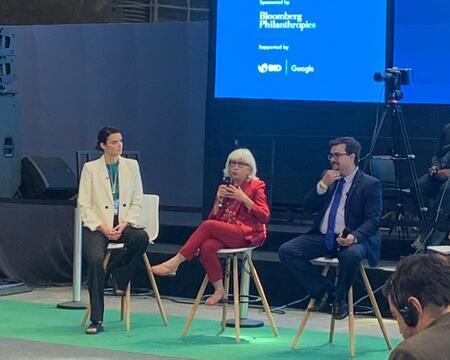
Laurence Tubiana speaking at G20 CHAMP panel
As part of the Under2 Coalition – the largest coalition in the world of subnational governments committed to be net zero by 2050 - climate group works with twenty Brazilian state members.
Ahead of the G20, a team from Climate Group’s Governments and Policy team co-wrote a policy brief for the T20 (a G20 Think Tank), calling on the vital role of states and regions to be recognized in multilateral processes and actions. The delegation joined a number of side events at the Urban20 and G20 Social Summits, where they highlighted the key role that subnational governments play in multilateral processes, driving ambition and implementing bold climate actions.
“States and regions have a vital role in the G20 process, they need a seat at the table and access to climate finance,” said Jebi Rahman.
“They are often the level of government closest to the people and territories that they represent, and they have a key role to play due to their procurement and investment capacity – their buying power."
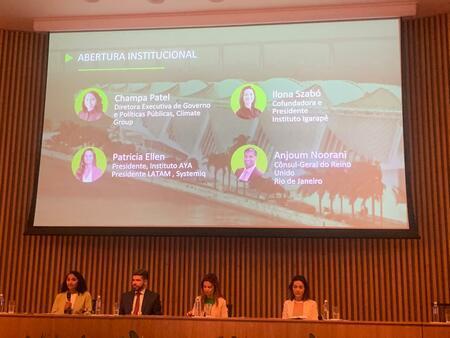
Champa Patel, Executive Director, Government and Policy sharing her reflections from Baku and the lack of progress on NCQG.
Top Highlights from Rio:
Contributing to the G20 Process
A joint policy brief with Regions4 that fed into the U20 and G20 communique: From Ambition to Implementation: How Including Subnational Governments Can Improve the Effectiveness of Multilateral Actions.
Mobilizing and attracting investment for subnational climate action
With ERM, we showcased our Brazil UK PACT project, Mobilizing Green Investment in Brazilian States. We also launched a Community of Practice at the Museu do Amanha , bringing together a large number of Brazilian states on the challenges and opportunities in attracting investment for states’ climate priorities.
With our partners Centro Brasil no Clima (CBC), Systemiq and Aya Institute, we brought together subnational actors and financial institutions. This included a World Bank representative that emphasized the importance of investing in state-level implementation as the best way to tackle climate change. They highlighted the role of states as coordinators, innovators and enablers of climate goals.
Multilevel governance and engagement
Our delegation joined the U20 Plenary session, which put a spotlight on CHAMP (Coalition for High Ambition Multilevel Partnerships). The session focused on multilevel action and how cities, states and regions are critical partners to meet the new round of NDC targets.
Looking ahead to South Africa, 2025
As Brazil hands over the G20 baton to South Africa, the outcomes from the summit have been mixed. On one hand, the declaration affirms the UAE consensus and the Global Stock Take, reinforcing the importance of tripling global renewables capacity, doubling energy efficiency and tackling deforestation.
However, there is one glaring exception – there is no mention of transitioning away from fossil fuels. To avoid backsliding, G20 world leaders should reinforce the phase out of fossil fuels. For a more detailed analysis on this, see Climate Group’s response to the G20 leaders’ declaration.
As COP30 in Belem, Brazil approaches, we look forward to working with our Under2 members and partners to unite leaders and drive change.