



%20(1)%20(1)-1.png)
There can be no climate action without finance – and allocating funding to mitigate, adapt and ensure communities are resilient enough to face the impacts of hurricanes, heatwaves and fires is one of the big challenges for governments across the globe.
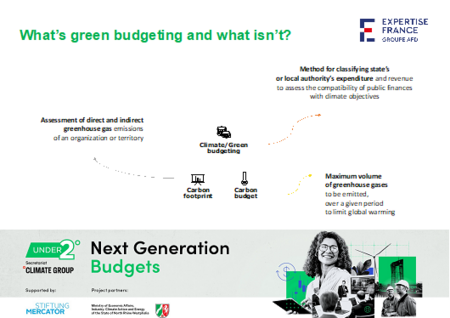
To address the challenge, Climate Group partnered with Expertise France - the French public international cooperation agency – to support Under2 Coalition’s subnational governments in adopting green budgeting tools. Green budgeting helps policymakers assess the climate impact of fiscal policies, leading to more informed and effective resource allocation while ensuring policies are consistent with decarbonization commitments. Together, this February we launched the Green Budgeting Training Course as part of our Next Generation Budgets project.
Throughout the course, 60 subnational governments’ officials explore how to strengthen their understanding of green budgeting as a tool to inform decision-making, achieve climate neutrality goals and better allocate public resources in a transparent way. The first module focused on exploring why green budgeting should be implemented and identifying the main principles and methods of implementation. For key takeaways, check out this article: Making Green Budgeting a success at state and regional level | Climate Group.
Next Generation Budgets is a project led by Climate Group, in partnership with the Government of North Rhine Westphalia and funded by Stiftung Mercator. Through the Next Generation Budgets-project, state and regional governments from Europe and North America receive technical training to green their budgets, and share best practices to to unlock climate finance for their territories.
Why should all states and regions implement green budgeting?
Clément Chevalier, Green Budgeting Expert at EcoAct kickstarted the training with three key reasons that underscore why subnational governments must green their budgets:
- the urgent need for climate action;
- the unique position of sub-national players, and;
- the role of finance in enabling the transition.
2024 was the first full calendar year to exceed 1.5 degrees of global warming compared to the industrial era, with devastating hurricanes, fires and heatwaves taking place all over the globe. These impacts bring huge challenges for governments at state and regional level as they face damaged roads, schools and water infrastructure, to name just a few.
Governments know how much they need to invest. In Europe, it’s equivalent to 5% of the European GDP by 2030. Analysis by the European Commission shows that, in the period from 2011 to 2020, an average of €764 billion was invested in the EU each year to reduce GHG emissions, equal to about 5.1% of the EU’s GDP in 2023.
To reach the 2030 target, the Commission estimates that an additional €477 billion in green investment is needed annually, or 3.2% of the EU’s GDP in 2023.
In the US, local action is essential to reach climate objectives. The Inflation Reduction Act could reduce greenhouse gas emissions by approximately 40% in the US by 2030 according to the Environmental Protection Agency , supporting the latest target set in the country’s Nationally Determined Contribution (NDC) for reducing greenhouse gas emissions by 61–66% by 2035.
The role of finance in the transition is pivotal. The fourth Helsinki principle for climate change – a set of principles established in 2019 by the Coalition of Finance Ministers to demonstrate their leadership in the response to climate change - states that climate change needs to be taken into account in macroeconomic policy, fiscal planning, budgeting, public investment management and procurement practices.
What are the first steps to implement a green budget?
Before anything else, subnational governments need to determine which green budgeting approach is most suitable for their needs. There is a key distinction between a broad sustainability-focused approach, which aligns public finances with the Sustainable Development Goals (SDGs), and an environmentally driven approach, which targets specific ecological priorities such as climate mitigation, biodiversity, and pollution control.
For the French local authorities who used the Environmental Axes Approach, the main advantage lies in the cross-cutting nature of environmental issues - the setting of the budget is the rare moment in the year when government departments sit around the same table to make strategic decisions.
As a second step, successful green budgeting requires a clearly defined scope. States and regions must determine the perimeter of their analysis, which typically includes key environmental dimensions such as climate change mitigation and adaptation, biodiversity conservation, water resource management, air quality, and sustainable resource use. The priority sectors under evaluation should at minimum cover agriculture, energy, industry, and the environment, as recommended by the OECD, while additional sectors can be phased in based on national priorities.
Green budgeting should also include a thorough financial scope, including government expenditures and revenues, taxes, and subsidies. It could gradually apply across the entire budgetary structure, covering not only the main budget but also annexes, public agencies, operators, and state-owned enterprises.
Additionally, it needs to be detailed enough - a greater granularity ensures more precise identification of green and non-green spending, thereby strengthening policy coherence and fiscal decision-making.
With this in mind, during the Green Budgeting Training Module, Next Generation Budgets officials and policy makers have been encouraged to take four key steps to set up their green budgets, identified by OECD green budgeting targets and principles and the UN knowing what you spend guidance. Through their Next Generation Budgets Project Worksheets, governments are tasked to:
- Defining the green budgeting framework – Establishing the scope, objectives, and methodology of the green budget.
- Implementing a tagging system – Developing a classification mechanism to track environmentally relevant expenditures and revenues.
- Integrating tagging into financial management systems – Embedding the classification system into existing budgetary and accounting structures for consistency.
- Monitoring and reporting progress – Regularly assessing the effectiveness of green budgeting efforts and ensuring transparency in implementation.
A critical factor for success tis the engagement with key stakeholders with strong political will.
To get started, participants were split into breakout rooms based on their nationality where they brainstormed which public policies should be supported by green budgeting and how they could formulate the main objective of implementing a green budget.
An interesting reflection was that while budget tagging appears focused on the present, the challenge is to leverage it effectively to shape a sustainable future. By fostering these discussions, Next Generation Budgets offers government officials and policymakers a valuable framework to collaborate and exchange ideas on common green budgeting challenges.