



Identifying spending that negatively impacts your climate goals
Next Generation Budgets explores tracking brown expenditures in green budgeting
As we near the final module of the Next Generation Budgets Green Budgeting Course, Module 3 puts a spotlight on a topic that’s often overlooked—but absolutely essential: tracking ‘brown expenditures’—public spending that actively works against our climate goals.
In the latest module, Clément Chevalier, Green Budgeting Expert at EcoAct, explains why identifying these harmful expenditures is just as important as tracking green investments. He also shared how governments can redirect funds away from polluting sectors and towards sustainable development.
The session also showcased ground-breaking work from the City of Oslo and the C40 Climate Budgeting Programme, offering climate budgeting tips and best practices.
So, what are 'brown expenditures'—and why do they matter?
Green budgeting is evolving. As it shifts from its first generation focused solely on identifying climate-positive spending to a more comprehensive second generation, it becomes essential to track ‘brown expenditures,’ that is - public spending that works against climate goals by allowing money to flow towards climate-harmful activities.
Brown expenditure includes:
- Fossil fuel subsidies
- Investments in high-emission transport
- Spending that is incompatible with carbon neutrality goals
Despite net-zero emission commitments from many countries, global fossil fuel subsidies hit $7 trillion in 2022—a staggering 7.1% of global GDP. This is largely due to the failure to factor in environmental damage. (IMF, 2023).
By identifying and quantifying these expenditures, using frameworks like I4CE , the EU Commission’s guidelines, or New York City’s approach, governments can address this imbalance and begin to reallocate funds away from polluting activities and towards their climate objectives. This approach aligns with Article 2.1 of the Paris Agreement, which which calls for financial flows to support low-emissions development and recognises that achieving climate objectives means both scaling up green investments and scaling down harmful ones.
Ireland's green budgeting approach
Since 2019, Ireland has tracked climate-favourable spending in its budget. Starting in 2024, the government expanded its efforts to also identify climate-unfavourable expenditures, assessing both direct and indirect impacts. Using six criteria aligned with the EU Taxonomy, the Irish government distinguishes between projects: for example, new builds on greenfield or underdeveloped sites are generally ‘unfavourable’ whereas energy-efficient retrofits are considered as ‘favourable’. Read more about Ireland’s recent updates to their green budgeting method here.
“Climate and environmentally unfavourable expenditure is defined as any expenditure which impedes, in whole or in part and whether directly or indirectly, Ireland’s transition to a low carbon, climate-resilient and environmentally sustainable economy, where it is evident that all, or at least the majority of expenditure on the programme in question, would likely contribute to a deterioration or disimprovement in climate and environmental outcomes - Department of Public Expenditure NDP Delivery and Reform
How can subnational governments include brown expenditures in their green budgeting approach?
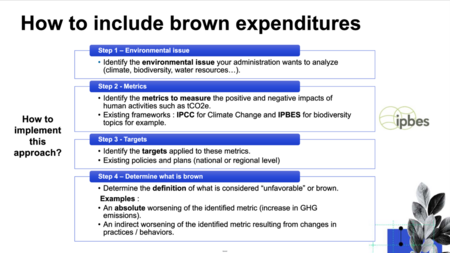
For local and regional governments looking to track brown spending, the steps are clear:
- Identify the key environmental focus (e.g. climate change, biodiversity)
- Identify relevant metrics to measure impact of activities (e.g. tCO2e)
- Align approved metrics with policy targets to evaluate if spending supports or undermines progress
- Define ‘unfavourable’ or brown expenditures as those that directly or indirectly harm these targets, such as increasing emissions or encouraging unsustainable practices
A word of caution: some expenditures don’t necessarily fit into ‘green’ or ‘brown’ categories. For example, nuclear energy or hydropower. Current methods don’t yet capture varying degrees of impact or cleaner alternatives, like gas replacing coal. A more detailed system using impact percentages is needed for better accuracy.
“Accounting for negative expenditure is inevitable if investment in climate change action is to be effective.” - UNDP
Lessons from the City of Oslo: Climate Budgeting in Action
We were thrilled to welcome Trude Rauken, Senior Advisor for International Climate Collaboration at the City of Oslo, to share Oslo’s innovative Climate Budget, first launched in 2017.
This tool integrates climate targets directly into the city's financial planning, ensuring that greenhouse gas (GHG) emissions are managed with the same rigor as fiscal expenditures. Oslo’s approach involves:
- Quantifying expected emissions reductions from each proposed measure.
- Assigning responsibilities for implementation
- Integrating measure into the city’s financial planning
This systematic process allows continuous monitoring and adjustment to stay on track with climate goals. Key features of Oslo’s Climate Budget includes:
- Integration with Financial Planning: The Climate Budget is embedded within Oslo's annual financial budget, making climate considerations a core component of all municipal decision-making processes.
- Emission Reduction Targets: Oslo has set an ambitious goal to reduce GHG emissions by 95% by 2030 compared to 2009 levels. The Climate Budget outlines annual emission limits to track progress toward this target.
- Oslo's Climate Budget has led to significant progress in reducing emissions and has served as a model for other cities worldwide as part of the C40 Climate Budgeting programme.
“So, if I should give one advice is to start with what you have a good data on and don't try to balance the budget and work actively, of course, with your governments finance (department)." - Trude Rauken
Oslo’s success has become a model for cities around the world, including those in the C40 Climate Budgeting Programme.
Insights from C40’s Climate Budgeting Programme : Building momentum in cities worldwide
We also heard from Henry Quintana, Manager of the C40 Climate Budgeting Programme. He emphasized the key success factors for climate budgeting including political commitment, strong administrative leadership, CFO ownership, and a climate-literate finance team. He reiterated the need for a ‘whole of government approach’ mainstreaming climate in the budgeting process. On budgetary integration he said, “We are not trying to reinvent the wheel, we are actually trying to add (climate) to the wheel that you (governments) already have.”
C40’s approach encourages early involvement of internal stakeholders and a phased approach with annual improvements. The City of London (who joined us in our kick-off module), has implemented its third climate budget, focusing on achieving net-zero by 2030, including adaptation actions, with a four-year phased approach that extends from government operations to the supply chain. The City of Mumbai, meanwhile, published its first climate budget in 2024, engaging over 20 departments and planning improvements for the next budget in 2025-2026 to meet their climate adaptation and mitigation targets.
C40 is working with 13 cities, some of which are located in Next Generation Budgets states and regions, Quintana concludes that, “we’re seeing great progress in cities.”
“Green budgeting encompasses several tools to bring climate and environmental considerations into budgeting and fiscal policies” - European Commission
Looking ahead: what complementary tools can be used?
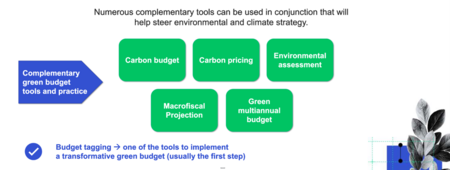
Complementary tools include carbon budgets to cap emissions, environmental assessments to evaluate project impacts, macro-fiscal projections to align economic and climate goals, and multiannual budgets to plan long-term green investments (such as the EU’’s pledge to allocate 30% of its 2021–2027 budget to climate-related spending). Subnational governments can also use the OECD’s free self-assessment tool to check their progress.
Next steps for Next Generation Budgets
In the fourth and last module of Next Generation Budgets’ ‘Green Budgeting Course’ we are looking forward to hearing participating governments’ implementation agendas before we kick-off the Community of Practice (CoP) meetings in June. Stay tuned for more updates here.