



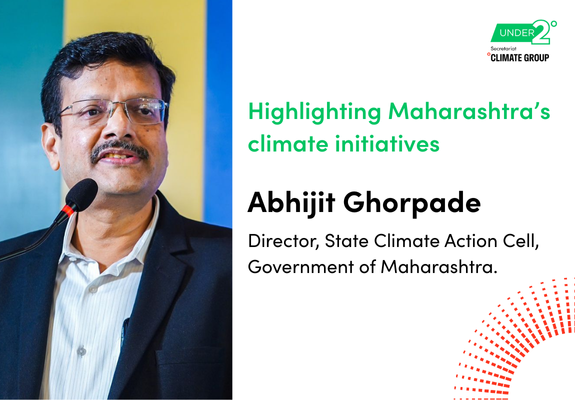
To understand the steps Indian states are taking on climate change, we’re organising strategic convenings, dialogues and high-level forums. The Subnational Leadership Interview series is among our efforts to shine a light on their climate planning, innovations and solutions. The following interview is with Abhijit Ghorpade, Director of the State Climate Action Cell, Government of Maharashtra.
Maharashtra is among the leading contributors to India's GDP and plays a crucial role in the national economy. How is the state also contributing to India's 2070 net zero goal and fulfilling the Viksit Bharat aspiration?
Maharashtra is the engine of India’s economic growth and one of the country’s most industrialised states. With an economy of $480 billion, it is the largest subnational economy and biggest contributor to India’s GDP. The state aspires to be India’s first trillion dollar economy by 2028.
At COP26 in Glasgow, India set the target of achieving net zero by 2070. Our challenge now is to align this goal with the ambition of becoming a trillion dollar economy. The solution undoubtedly lies in charting a sustainable development path, which is precisely what the state’s climate action plan outlines.
Energy is central to the green transition. We're committed to transition from fossil fuel-based energy to renewable energy. In 2020, 72% of our energy came from coal, with only 16% from renewable sources. The State Action Plan on Climate Change (SAPCC) aims to increase the share of renewable energy to 50% by 2030.
The state is also actively promoting the adoption of green technologies and energy efficient practices in industries to reduce their carbon footprint without compromising productivity. Maharashtra has introduced a Green Hydrogen Policy, aiming to make the state a green hydrogen hub.
We also recognise that the energy transition must be fair, just, inclusive and equitable. Our goal is to maintain prosperity without creating any social disruption. To achieve this, we've launched the Just Transition Roadmap. We've identified 14 districts with the highest concentration of fossil fuel industries. These include coal mines; thermal power plants (TPPs); iron and steel, petroleum, chemical, cement plants; brick kilns and foundries. We're creating just transition plans for these districts and are focusing on skilling, reskilling and upskilling of the workforce. We're transforming the infrastructure to support renewable energy and providing social safety net to the displaced workers.
Also, a third of emissions come from the transport sector. We launched an Electric Vehicle (EV) policy in 2021, which incentivises both EV manufacturers and consumers. We're strategically promoting EVs - with a focus on public transport and three wheelers, including tempos - to improve last mile connectivity.
Maharashtra is the third most urbanised state in India. Having prepared the SAPCC, we're now working on district and city level climate action plans. Dedicated climate action cells have been set up at the city and district levels. We're focusing on 43 AMRUT cities which are committed to achieving net zero emissions by 2050. We've developed City Climate Action Plans for Mumbai, Solapur, Nasik and Sambhaji Nagar. Plans for four more cities are in progress.
Since about a third of emissions are from buildings, we've launched the “Decarbonisation Roadmap for Maharashtra’s Cities” which includes measures such as rooftop solar; improving energy efficiency; reducing energy losses; using sustainable building materials; retrofitting and introducing clean cooking ranges. For rapid urbanisation, we're focusing on green infrastructure development, effective solid waste management, efficient water resource management and expanding urban green cover to counter the green island effect.
Maharashtra has revised its State Action Plan on Climate Change (SAPCC) to align with the updated framework and guidelines issued by the Ministry of Environment, Forest, and Climate Change (MoEFCC). What are the major changes in this new version?
Maharashtra drafted its SAPCC in 2014. The Plan has been updated following the Union government’s revised framework and guidelines. While the previous plan focused on adaptation, the revised plan strikes a balance between adaptation and mitigation.
The SAPCC analyses climate trends between 1970 and 2020 and projects changes from 2020 to 2050. It assesses vulnerabilities related to rising temperatures, erratic rainfall, sea level rise, droughts, floods and cyclones at the district and subdistrict levels. Hot days have doubled in the last 50 years, droughts and cyclones have tripled, and floods have quadrupled over the past decade. Notably, 25% of districts are experiencing both droughts and floods.
The Plan outlines adaptation strategies for agriculture, water resources, public health, tourism and tribal development. It also presents mitigation strategies for energy, transportation, industry and forestry. In response to the projected rise in temperatures, it introduces the State Cooling Action Plan, which is aligned with India’s National Cooling Action Plan, focusing on agriculture and buildings. Given that 30% of fruits and vegetables are lost due to a lack of cold storage, the Plan recommends establishing cold storage chains at the village level.
A key innovation in the SAPCC is the use of Decentralised Renewable Energy (DRE) technologies such as solar pumps, solar dryers, milk chillers and vertical fodder grow units, particularly in agriculture and allied sectors. DRE can address the state’s unreliable electricity supply, improve productivity, and ensure energy security while creating employment.
The Plan also introduces climate finance, which will lead to a climate budget. Last year, the state allocated close to 12% of its annual budget to climate action, with plans to increase this allocation to 50% by 2030.
The SAPCC acknowledges that women and children are the most vulnerable to climate change impacts. The Plan prioritises gender mainstreaming and youth engagement, ensuring inclusivity across all sectors. It provides special provisions for tribal communities, protecting their traditional knowledge and strengthening livelihoods, particularly in relation to non-timber forest products (NTFPs).
What do you think is the role of state-level climate action in achieving India’s updated Nationally Determined Contributions (NDCs) under the Paris Agreement?
India is a signatory to all major international climate change conventions, and the SAPCC aligns with the country’s commitments, particularly its NDCs under the Paris Agreement.
India aims to reduce its the emission intensity of its GDP by 45% by 2030. The SAPCC supports this by promoting alternative energy in industry and transport, and enhancing grid efficiency by reducing transmission losses from 26% in 2020 to 15% by 2030.
The country is also committed to reducing its reliance on fossil fuels for electricity generation by 50% by 2030. The SAPCC focuses on reducing coal usage to 46% and increasing renewable energy (RE) contribution to 50% by 2030.
India plans to enhance its natural carbon sink by 2.5 to 3 billion MT CO2e. The SAPCC recommends expanding tree cover outside forests. Maharashtra has established the Chief Minister’s Task Force to promote large-scale bamboo plantations. Bamboo is fast-growing, uses minimal water and sequesters more carbon than other plants.
Maharashtra’s revised SAPCC shows how state-level strategies can complement national climate goals, balancing economic growth with climate commitments to build a sustainable, resilient future.
The Mazi Vasundhara Abhiyan (My Earth Mission) is Maharashtra’s flagship programme to encourage local climate action through people’s participation. How crucial is community involvement in driving climate action in the state? What are the approach's challenges and opportunities?
The Mazi Vasundhara Abhiyan highlights the significance of community participation in climate action. Rooted in the belief that climate change results from the imbalance of nature’s five elements (earth, water, air, fire and space), the programme encourages restoring balance through local efforts. It incentivises climate action by organising competitions among local self-governing bodies around these five elements, offering cash prizes to top performers.
The initiative entered its fifth cycle in 2024-2025 and has achieved remarkable success, with over 28,000 village panchayats, municipal councils and corporations registering their participation. By the end of the last cycle, nearly 29 million trees were planted, 52,000 green spaces created, 370 MW of solar capacity installed, and 2,270 MCM of water conservation potential created. This underscores the importance of grassroots mobilisation in addressing climate challenges and highlights the vital role of communities in Maharashtra's climate agenda.
Community involvement is key because climate impacts vary across regions. Local communities have firsthand knowledge of their environment and are best positioned to devise practical, context-specific solutions. Encouraging sustainable practices at the community level also fosters a long-term cultural shift towards climate-friendly behaviors. Small, community-driven initiatives can collectively lead to significant emissions reductions and improved resilience. It also empowers marginalised groups, ensuring climate action benefits rural and vulnerable communities.
However, challenges exist. Culturally, changing established practices and encouraging communities to adopt sustainable alternatives requires sustained efforts and trust. The biggest challenge is capacity building - many local bodies and communities lack awareness of climate change impacts and the technical expertise needed for effective solutions. Limited financial resources at the grassroots level can also hinder impactful climate initiatives. Similarly, coordinating local, district, and state level climate strategies can be complex.
To address these challenges, we conduct webinars and workshops for capacity building and ensure coordination through the State Climate Action Cell, which works with local governments, departments and civil society organisations.
States face a critical shortfall in climate finance for transitioning to a green economy. Can you share an example of how your state has accessed national or global funds beyond its budget for a climate action initiative? How important is this financial support in your state's context?
Presently, the bulk of the state’s climate finance comes from public funds. In FY 2023-24, almost 12% of the state’s budget was allocated to climate-related activities, with 79% focused on adaptation, 20% on mitigation, and 1% on cross-cutting initiatives.
The SAPCC calls for a 5% annual increase in the climate budget. However, as climate challenges intensify and action deepens, public finance alone will not suffice. The state must explore innovative financial instruments and tap into alternative sources beyond its own budget. Maharashtra has actively leveraged national and international funding mechanisms to supplement its efforts. For instance, the Maharashtra Climate Resilient Distributed Renewable Energy Access Programme, supported by the Asian Infrastructure Investment Bank (AIIB), promotes off-grid solar pumps for farmers and strengthens the electricity distribution network’s resilience.
In partnership with the 2030 Water Resources Group (2030 WRG), Maharashtra secured $270 million from the Green Climate Fund (GCF). This will support integrated watershed programmes like the Jalyukt Shivar Yojana, address drought-prone areas and enhance water security.
The Enhancing Climate Resilience of India’s Coastal Communities Project, funded by GCF, focuses on restoring coastal ecosystems like mangroves and supporting climate-adaptive livelihoods in Maharashtra’s coastal districts.
The state has also accessed the National Adaptation Fund for restoring degraded forest lands among other projects.
Maharashtra recognises the importance of accessing climate finance not only for funding but also for co-benefits, such as capacity building and the adoption of innovative technologies. National support ensures that marginalised communities can transition to a green economy without bearing disproportionate costs.
While Maharashtra looks at alternative sources of climate finance, certain challenges remain. Firstly, aligning state priorities with global and national funding criteria requires meticulous planning and coordination. Navigating complex application processes and compliance mechanisms can delay fund mobilisation, particularly at the local government level due to insufficient capacity and monitoring systems. Consequently, there is a lack of bankable projects at the local level.
Despite the challenges, Maharashtra is committed to overcoming them by building partnerships, streamlining processes and mobilising technical expertise to effectively leverage climate finance.
Maharashtra is vulnerable due to recurring extreme weather events such as droughts, floods and erratic rainfall. This causes huge economic losses, threatens food security and livelihoods. Please share any major initiatives the state has undertaken to promote adaptation and resilience primarily within the agricultural sector.
In spite of being the third most urbanised state in the country, 50% of Maharashtra’s population still relies on agriculture, contributing 12% to its GDP. However, agricultural productivity is hindered by limited irrigation - only 18% of the state’s land is irrigated, leaving 82% rain-fed. Additionally, 79% of the state’s farmers are either small or marginal, with uneconomic landholdings. Climate change has exacerbated these challenges, leading to substantial crop losses. Over 36 million hectares have been impacted in the last five years.
To build resilience in agriculture, Maharashtra has launched several key initiatives. The Jalyukta Shivar Abhiyan focuses on watershed management, groundwater recharge and drought-proofing villages through community-driven water conservation efforts. The Chief Minister’s Sustainable Agriculture Irrigation Scheme promotes micro-irrigation and farm ponds to ensure water availability, reduce crop losses during dry spells and improve productivity.
The Nanaji Deshmukh Krishi Sanjeevani Prakalp (PoCRA), supported by the World Bank, targets drought prone areas by implementing climate resilient farming practices in over 5,000 villages in Marathwada, a region with the highest agricultural and water risks.
The SMART Project co-funded by the World Bank is strengthening agribusiness infrastructure, value chains and promoting climate resilient practices that benefit marginalised communities. The SAPCC also supports organic farming, drip irrigation and micro-irrigation, while the ridge-to-valley watershed development programme focuses on recharging groundwater in drought prone areas.
The State Climate Action Cell is working with the Agriculture Department to improve soil quality, particularly its organic carbon content. The Chief Minister’s Task Force on Environment and Sustainable Development is working to promote bamboo plantations. The Harit Maharashtra programme is encouraging tree planting, horticulture, floriculture and medicinal plant cultivation through MGNREGA, the country's biggest rural employment guarantee scheme, to strengthen farmer livelihoods.
To address challenges such as high upfront costs, regional disparities and lack of awareness, the state is focusing on capacity building, financial support and improved implementation frameworks. These efforts aim to safeguard livelihoods, ensure food security and build resilience in Maharashtra’s agricultural sector.
Don't miss our earlier interview with James Sangma, where he unpacks how Meghalaya is shaping a climate-first economy and what other states can learn from its bold approach.