



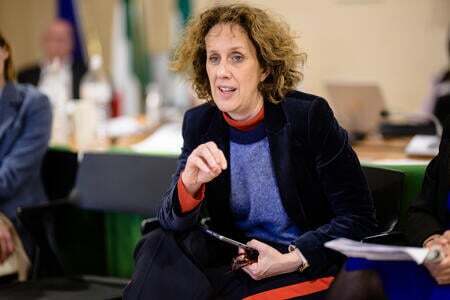
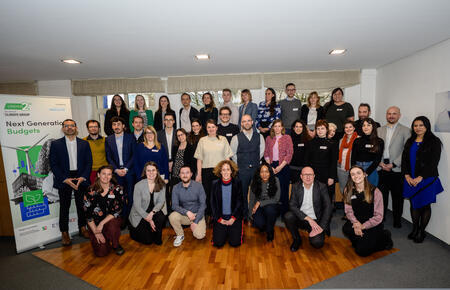
As part of our EU in Focus week, our CEO, Helen Clarkson, is in Brussels attending the Next Generation Budgets workshop. She opened the session with a speech emphasising the importance of greening subnational budgets.
Good afternoon,
It's great to be here in Brussels for this important Next Generation Budgets workshop.
For those that are less familiar with our work, Climate Group is an international non profit launched in 2004. We currently work with more than 600 of the world’s largest businesses, to drive climate action, fast. And almost since the start, we’ve worked with subnational governments. Currently, there are 183 influential regional provincial and state governments in the Under2 Coalition, for which we are the secretariat.
Us being here together highlights an undeniable reality; climate change knows no borders.
But as you all know this critical work we do needs financing, and that is what we’ll be looking at today. So, thank you for joining us to dive deep into green budgeting, and finding innovative ways to unlock climate financing at subnational level.
Subnational governments have real power.
That is why your leadership has never been more vital. When national priorities waver, it’s states, regions, and cities that provide continuity, resilience, and ambition.
While national and federal governments design broad policies, it’s you who implements these action plans. You are the scaffolding holding up the house of global climate ambition. You have the power to influence. To drive action through implementation – managing resources, raising finances, and setting bold policies on the ground.

This year marks the 10th anniversary of the Under2 Coalition.
That’s 10 years of subnational climate leadership, driving local action and global impact aligned with the Paris Agreement. What began as a commitment between a handful of governments in Paris 10 years ago in May, has evolved into a network of 183 governments, accounting for 50% of the global economy, and representing two billion people.
Your impact over the last decade is undeniable. Through your leadership, you have collectively delivered significant emissions reductions, with many of you achieving cuts aligned with 1.5°C pathways. As a coalition you have reduced your emissions by 16% while global emissions were rising by around 42%.
You have driven scores of transformative climate policies across energy, transport, nature, and just transition — from California’s landmark 100% clean energy law to Scotland’s Just Transition framework. And through the Future Fund, you have supported over 40 governments, many from developing economies bearing the full brunt of the climate crisis.
We’ve worked with you on influencing policy across the world and across a wide range of sectors from carbon credits with farmers in Brazil, to managing mangrove swamps in Nigeria, from waste management in South Africa to livestock production in Peru. And we’ve brought together governments to learn lessons from each other and exploring common challenges for example linking Yucatan in Mexico to British Colombia in Canada, and Queensland Australia to Parana Brazil.
Our partnership with Stiftung Mercator and North Rhine Westphalia goes back a few years and has focused on projects like this, sharing knowledge and lessons across the Atlantic – previously on the energy transition and the industrial transition.
And of course in the last couple of years we’ve been working really hard to push the voice of sub-nationals up to the UNFCCC processes so that it can be heard at COPs, and have launched the CHAMP coalition which we are continuing to drive forward as we are now in the NDC revision process and heading to COP30.
This truly is a Coalition where we think and act both globally and locally.
In this crucial year, climate finance and green budgeting will be key to sustaining progress. Commitments alone won’t cut it; we need robust financial frameworks and investment strategies to turn ambition into meaningful action. Every dollar of public spending needs to have climate as a pre-condition.
Simply put, we need to keep greening subnational budgets. Without integrating climate action into financial planning, even the most ambitious policies can become unfunded aspirations.
And that’s why projects such as this are so important and are at the heart of what we’re doing as a coalition.
I am grateful to the government of North Rhine-Westphalia for its leadership in collaborating with us on this initiative. Many thanks to our funder Stiftung Mercator for their generous support.
I also want to thank all the subnational governments here today, particularly Lombardy for hosting us.
As we move forward, we must ask ourselves, how can we better integrate climate action into our financial planning? As we celebrate 10 years of subnational leadership, what do the next 10 years look like? What innovative strategies can strengthen our commitment to green budgeting and climate finance?
Let us reflect on these questions as we build a well-financed net-zero future together.
Thank you.