



How state and regional governments plan for and spend their budget is a statement of intent. It can be a powerful tool to cut harmful emissions too. The second module of Next Generations Green Budgeting course was on green budget tagging. This is a key tool of budgetary policy to assess and identify how budget items and policies contribute to overall climate mitigation objectives. Our technical partners Expertise France and EcoAct joined us to share their insights, bringing experiences from regions that have tested this approach in France. During the online module, policy makers and public servants from Baden-Württemberg, Basque Country, Catalonia, Colorado, Emilia-Romagna, Hawai’i, Lombardy, Maryland, North Rhine-Westphalia and Wales joined the training and shared their perspectives and challenges on what it takes to carry out green budget tagging regionally.
What is green budget tagging and why should regions use it?
Green budgeting offers a range of tools and techniques for governments seeking ways to bring climate and environmental perspectives to account on the budget process. A key green budgeting tool is green budget tagging, which is also broadly recognized as the easiest to scale and a great entry point to the green budgeting approach. According to the OECD, tagging involves “assessing each individual budget measure and giving it a “tag” according to whether it is helpful or harmful to green objectives”. The process involves analyzing the budget line by line against a list of actions – or taxonomy – and their compatibility with the goal of achieving the regional climate targets, for example carbon neutrality by 2050. Other green or sustainability objectives could be assessed this way, such as biodiversity, air quality and water.
Information gathered from tagging individual expenditures can be useful to understand how overall budget policy impacts climate commitments at the subnational level. As reported by The Institute for Climate Economics, the objective is to ‘improve the impact of the budget on the climate year on year, through ensuring that actions and investments progressively eliminate expenditure with a negative impact on climate mitigation and increase expenditure that supports the transition to net zero emissions’.
How can regions define what is in line with climate goals and what isn’t?
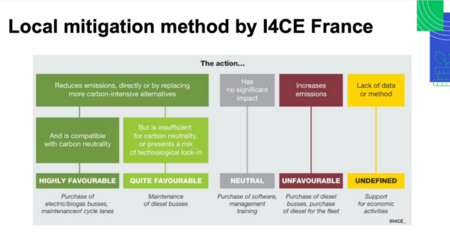
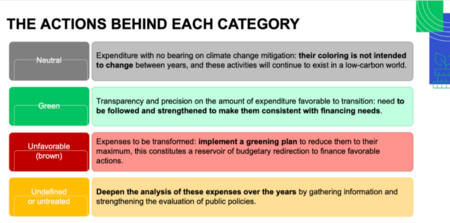
A solid classification system is key to ensure green budget tagging has a meaningful impact on informed decision making and resources allocation. One widely used classification framework to guide green budget tagging is the French local mitigation methodology developed by I4CE. It rates actions based on their impact on climate mitigation as highly favourable, favourable (green), neutral (grey) or unfavourable (brown). The "green" category is divided into dark green (for those actions are fully aligned with carbon neutrality) and light green (actions that do not achieving full climate neutrality, but still contribute to emissions reductions). Actions with no significant impact are classified as neutral, while those that increase emissions are deemed unfavourable. If insufficient data is available, the action is labelled as undefined, encouraging governments to seek for more information.
Another classification system regions can use is the European Union Taxonomy Regulation, which entered into force in 2020 and defines criteria for economic activities that are aligned with a net zero trajectory by 2050. With the EU Taxonomy the goal was to establish a clear and consistent definition of what constitutes a sustainable economic activity, aligning with the objectives of the European Green Deal, while helping prevent greenwashing. State and regional governments can also use it as a common framework for identifying and classifying climate mitigation activities enabling more transparent spending and investment decisions. Next Generation Budgets government participants are encouraged to inform their own classification system with as many resources as possible and to adapt existing framework to their own requirements.
How different regions are implementing green budget tagging
Frédéric Ollivier, General Director at the government of Normandy, France shared his region’s journey. Normandy, with a population of 3.3 million, has allocated a 2025 budget of 2.13 billion € (2.21 billion USD), which includes 1.3 billion € for operating costs and 800 million € for investments. The region's main responsibilities cover transport, high schools, vocational training, economic development, and environmental planning. In 2023, Normandy began evaluating the environmental impact of its budget, aiming to better integrate climate and environmental considerations into its policies. Since 2024, local authorities are required by French law to assess investments based on the European taxonomy. Normandy's green budgeting approach, led by the Finance and Energy and Environment departments, focuses on seven pilot departments representing the region's highest investments. It aims not just to classify expenditures as 'favorable,' but to identify and promote sustainable practices, with a focus on carbon neutrality and future improvements in projects.
Justine Dalphin, Director of Ecological Transition at Essonne, also shared her government’s experience with green budget tagging. Her department, with over 1 million residents and an annual budget of 1.5 billion €, oversees areas such as social welfare, transport, education, and culture. As one of the first French departments to adopt green budgeting, it began its third climate mitigation analysis in 2025, covering 100% of internal departments and 470+ budget lines. This process identified 40 favourable actions and 30 greening options. Co-led by the Finance and Ecological Transition Departments, the green budget framework follows a structured timeline, with budget classifications finalized by December. Over time, unclassified expenditure has decreased from 40% to 5%. In 2025, Essonne plans to expand its analysis to include biodiversity and streamline data entry to better support environmental decision-making.
When going to breakout rooms, Next Generation Budgets governments exchanged views on the subject. For example, Wales has no official green budget tagging yet, though they have some experience with gender budgeting which could inform their green budgeting approach. Baden-Württemberg uses two tags - one for climate protection and one for nature conservation, using the EU taxonomy as classification system. Catalonia has developed a green budgeting methodology shaped by the Rio Markers which systematically quantifies green expenditure for climate change mitigation and adaptation. Results are compiled in the Climate and Environmental Perspective Report, which since 2022 has been included as supplementary documentation alongside the annual budget bill, which is now mandated by law. None of the states and regions in the project have yet piloted a tagging system for brown/unfavorable expenditures yet, which is something we will look at in the next modules.
The time to implement green budgeting is now
Drawing from France’s experience, developing subnational green budget tagging methodologies can take up to five years—so the sooner governments begin, the sooner they’ll reap the benefits, which include:
- Providing state and regional policymakers with a clearer understanding of the environmental and climate impacts of their budget choices.
- Increasing transparency by providing data on climate-relevant spending and prioritizing climate investments
- Improve cooperation and communication between finance and climate Ministries, mainstreaming climate considerations into budgetary policy.
With a sound methodology, green budgeting will have a positive impact on decision-making to ultimately align public budgets with climate neutrality commitments and to prioritize public policy projects based on their climate and environmental impact.
Over the next two months, the Next Generation Budgets, will continue to delve deeper into the implementation phase in the last two modules.