



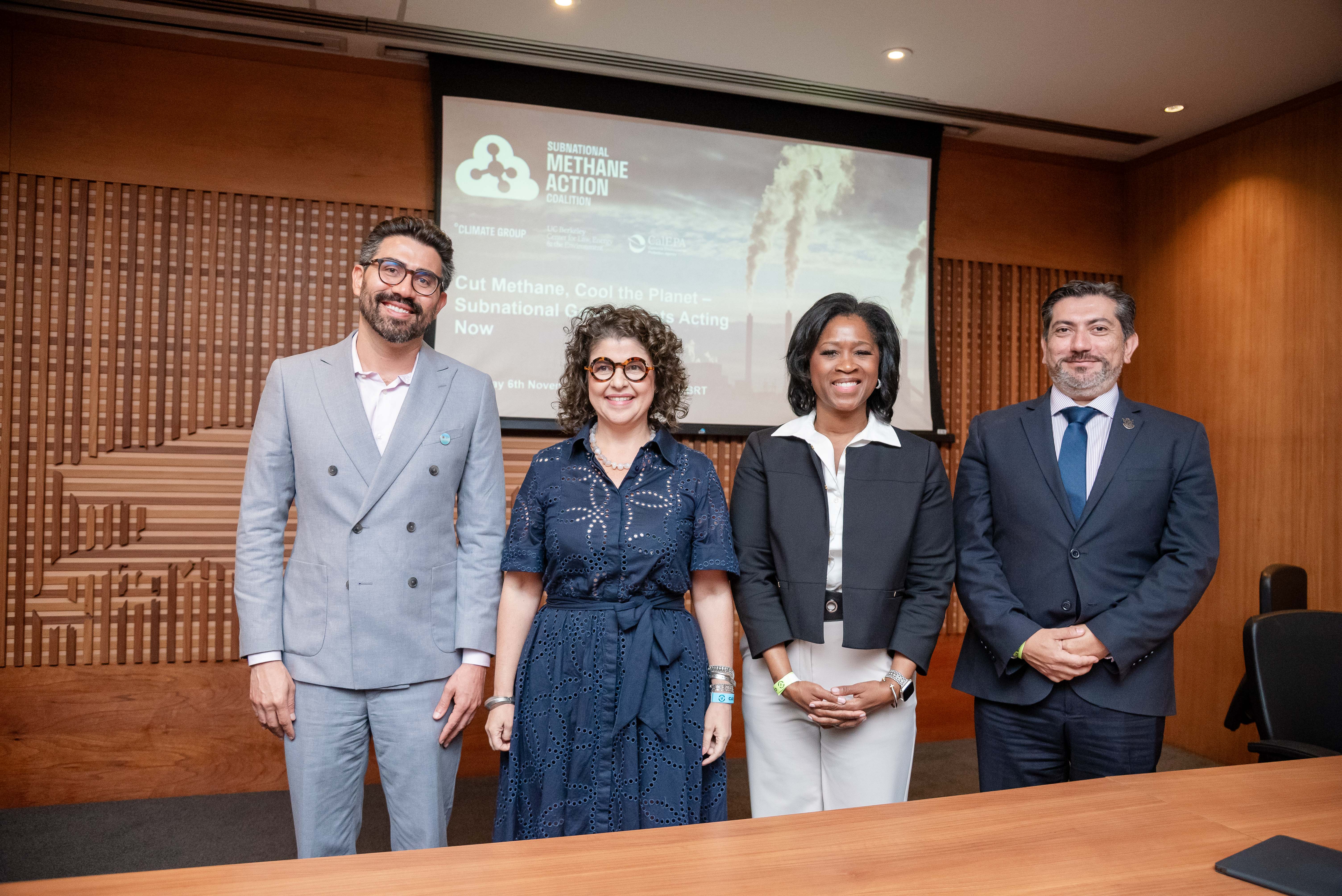
To champion methane as a COP30 priority, Climate Group hosted leaders from frontrunner state and regional governments slashing methane emissions – the fastest way to slow climate change. On 6 November, we brought together representatives from the states of Goiás (Brazil), Maryland (U.S.) and Querétaro (Mexico) for a packed-out, high-level panel discussion in Rio de Janeiro, Brazil.
Highlighting the potential for state, regional and provincial governments to lead the urgent global fight against methane, the event – Cut Methane, Cool the Planet – Subnational Governments Acting Now – focused on policies, practical programmes and financing to cut emissions and pull an emergency brake on climate change.
Hosted by Jebi Rahman, Head of Global Implementation at Climate Group, which coordinates the Subnational Methane Action Coalition (SMAC), it was the second ever in-person meeting of the world’s largest coalition of states and regions that are driving down methane emissions.
Rio de Janeiro signs up to methane coalition
The State of Rio de Janeiro became SMAC’s 23rd member at the event, held at its government seat, the historic Guanabara Palace. Ana Asti, Deputy Secretary for Water Resources and Sustainability for the State of Rio de Janeiro, was welcomed into the coalition by Champa Patel, Executive Director for Governments and Policy at Climate Group, and Wade Crowfoot, Secretary for Natural Resources for California. The U.S. state founded SMAC at COP28 in Dubai (2023).
Champa Patel said: “We’re proud to welcome the State of Rio de Janeiro to this vital coalition. Tackling methane is one of the most urgent challenges in climate action.
“Methane has more than 80 times the short-term warming power of carbon dioxide, so cutting its emissions acts as an emergency brake on climate change. Subnational governments are on-the-ground regulators, and they’re critical to drive concrete action across agriculture, energy and waste – the main sources of methane emissions.”
Zero landfill in Goiás
In the panel discussion, Andrea Vulcanis, State Secretary of Environment and Sustainable Development for the State of Goiás, Brazil, said that reducing methane emissions is not just an environmental goal, but a concrete strategy for sustainable development – especially when it comes to waste management. Like many developing regions, the Brazilian state is blighted by open-air landfills, which release methane into the atmosphere. Goiás’ ambitious solution is its Zero Landfill Program, which aims to close landfills and transform waste into economic and social opportunities.
Started in 2023, the program has already resulted in 125 municipalities upgrading to environmentally sound waste disposal – representing 72% of the state’s total waste. Moreover, the state has issued 78 licenses for the closure of landfills. Vulcanis explained how SMAC’s technical support has been essential in terms of the adoption of best practices when closing open waste sites, regionalising waste management and planning for the creation of biogas plants that can turn waste into low carbon energy.
Maryland embraces public-private partnerships
Collaboration between the public and private sectors to unlock mass methane reduction was a key topic for Serena McIlwain, Secretary of the Environment, Maryland, USA. She said that Maryland aligns state waste mandates, county collection systems and private-sector technology to stretch every dollar – proving that even with tight budgets, cross-sector coordination delivers results.
For example, the state’s food waste law requires large generators to divert organic waste from landfills. To help counties and businesses comply, it offers both grants and technical assistance. Meantime, Maryland’s Animal Waste Technology Fund means that the state partners with farmers to invest in digesters and waste-to-energy systems that cut methane from the atmosphere while producing clean power from livestock waste and slurries.
Querétaro’s perspective on overcoming barriers
Ricardo Javier Torres Hernandez, Undersecretary of Environment, Querétaro, Mexico explained that one of the big barriers in the way of mass methane action at scale is the lack of mechanisms to enable collaboration between local governments, academia and the private sector. He said that state and regional governments usually lack the skills and resources to identify, assess and implement methane reduction technologies – while research results and innovative solutions too often remain in universities. Bringing the two together requires shared spaces where science can be translated into viable local policies, which is what SMAC is all about.
Torres Hernandez also said there’s a huge need for more investment in methane leak monitoring technology – like satellites – to generate the accurate data that underpins informed decision-making. In addition, he said that there’s a lack of innovative financing mechanisms that channel funds directly to state and regional government projects.
Subnationals driving global progress
The panel’s moderator – Henrique Bezerra, Regional Lead – Latin America for the Global Methane Hub, a founding funder of SMAC – wrapped up the event by saying, “Today we’ve heard clear evidence that subnational governments are leading the way on methane reduction. As we look ahead to COP30 in Belém, these perspectives remind us that subnational leadership can drive global progress.”
Find out more: Subnational Methane Action Coalition | Climate Group