



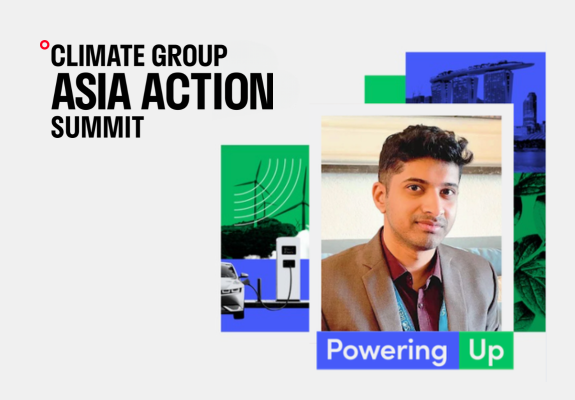
Grid congestion, volatile geopolitics, the race to attract hyperscalers and their investment, energy efficiency and AI driven solutions. Hear from Ember’s Interim Managing Director Aditya Lolla about the challenges and solutions around Asia’s transition.
Ember is Knowledge Partner of the Climate Group Asia Action Summit. Aditya Lolla will be speaking at the event in Singapore on 21 May, at the session: From generation to intelligence - building resilient grids in a connected Asia
Asia is leading the transition, and the electrification of economies. But what are the two or three biggest challenges to building resilience in Asia’s power system?
The energy transition is characterised by two massive, simultaneous forces: rapid electrification and clean energy expansion. The momentum in Asia is largely being driven by a handful of countries, with China leading the charge and India also rapidly picking up speed. But building genuine resilience faces three distinct bottlenecks.
The first is the policy and regulatory landscape. The technology is ready, capital is waiting – but it’s risk averse. So, you need modern regulatory frameworks to instil confidence and foster new markets. Countries do that by sending macro signals through big, ambitious announcements, like India saying it wants 500 gigawatts non-fossil capacity by 2030. They’re saying: ‘come to this country’.
In places where there there’s a bit of market maturity, the conversations move more at project level, for which governments have different policy levers and options to de-risk them. Ensuring that there is a timely schedule for grids, infrastructure, land acquisition, storage, things like that.
Ok, the regulatory landscape is first challenge. What are the second and third one?
The second one is grid infrastructure. Clean energy, particularly solar, is expanding at a breakneck pace, and it's hitting its physical limits. So,there are curtailments and reliability issues. All countries will need to think about that, in the coming years.
The third challenge is the volatile geopolitics. It’s creating uncertainty for investors – that was already the case before the conflict in the Middle East. Companies and governments are thinking how they can build the next generation infrastructure - that’s already a massive challenge, and then there’s this environment where the risk premiums are even higher.
What are some of the solutions?
Policymakers must focus ruthlessly on policies for market creation and grid modernisation. Oil and gas will continue to play a role, but at the at the end of the day, you need to think about the future of the energy system and for that, you need to implement regulations that value flexibility, storage, clean energy.
At an innovation level, in the short term countries can look at grid enhancing technologies to squeeze more capacity out of existing wires. And of course AI, to unlock more value from the grid. In the midterm, you'll need utility scale battery storage to absorb solar peaks and prevent curtailment. And longer term, we'll need the smart transition buildouts. Regional interconnections, solutions for the industrial sector and its decarbonisation.
How far is Asia in developing that interconnection between countries?
Singapore is probably the frontrunner in the ASEAN region, and Indonesia is thinking about subsea cables with Australia. At the same time, the big subsea cable manufacturers are trying to understand the policy landscape – they’re focused on risk premiums and cost of capital. And what Singapore especially is doing really well is to create that certainty by saying: ‘this is a priority for the country’.
Is it a model that you will see being rolled out across different parts of Asia?
It will become increasingly important. Diversification is a good hedge, as we’re going from a global protectionism phase to regional collaboration on specific issues like energy. Especially in Asia, you'll see a lot of regional cooperation mechanisms coming into play.
It’s part of country’s energy security strategy. What are the big opportunities there?
One is, of course, AI, also to unlock efficiency. You're seeing examples of that already, with Google's DeepMind predicting wind patterns to unlock the value of wind by 20% or even more. And Nvidia is working with utilities in Johor, in Malaysia, to stimulate grid flows.
Countries are facing a choice between continued cost of vulnerabilities based on oil and gas, versus the one-time cost of transformation. But you should not see them as costs: they are investments decisions, and investments come with returns. As the cost of solar and battery have fallen so dramatically, countries can now make decisions which they couldn’t take a few years back.
And we haven’t even mentioned electrification yet, really.
The world is underestimating how quickly electrification and clean energy expansion are converging in Asia. That’s where the story is, and it’s much of the energy demand growth in Asia. Especially China and India deploying solar and EVs faster than any region, they’re fundamentally rewriting energy economics.
What are some of the innovations that are flying under the radar?
Utility scale battery storage doesn't get talked about as much as other like technological shifts, like AI. But it’s becoming one of the most critical innovations in solving the instability challenges. It will take a few years to become mainstream, but it is almost there.
Then there are the grid enhancing technologies like Dynamic Line Rating and Advanced Power Flow Controls. They're incredibly scalable, and offer a fast and cost-effective way of upgrading grid capacity without waiting years for new transmission lines.
And the third bit is more on advanced forecasting and grid orchestration - software innovations that predict the variability of renewable output and matching it with dynamic demand. Hyperscalers are really excited about these things, so that’s certainly one to keep an eye on.
You mentioned AI a few times - what will its impact be in Asia?
Hyperscalers that invest in AI want to bring in vast capital for clean and stable energy; their demand will underwrite the next massive wave of clean energy and storage. The question is, are Asian countries ready for it? To a certain extent, they are, but in different ways in different countries. Malaysia has been very proactive in getting the hyperscalers to come in and talk. But other countries, like Indonesia, India, Thailand, Singapore, are also talking to hyperscalers.
So, there’s a competition going on?
There is a bit of a race going on, yes. Governments want foreign investment, but also protection from the downsides. That's where the conversations are at.
You mentioned the volatile geopolitics. What is the impact of that on Asia's transition?
The most exposed countries are China, India, Japan; but they inherently are a bit more resilient. There are countries which are actually vulnerable like Bangladesh, Pakistan, and Thailand.
The disruptions in Middle East highlight the economic vulnerability of relying on global oil and gas supply chains. I'm not saying ‘switch everything off’; that's not possible, and in the short term some countries might rebound to thermal energy, or gas and oil. But in the long term, this will be a powerful catalyst to diversify and embrace clean energy. No country wants to be pushed around by bigger superpowers, so the conflict reinforces the acceleration to domestic, clean alternatives.