



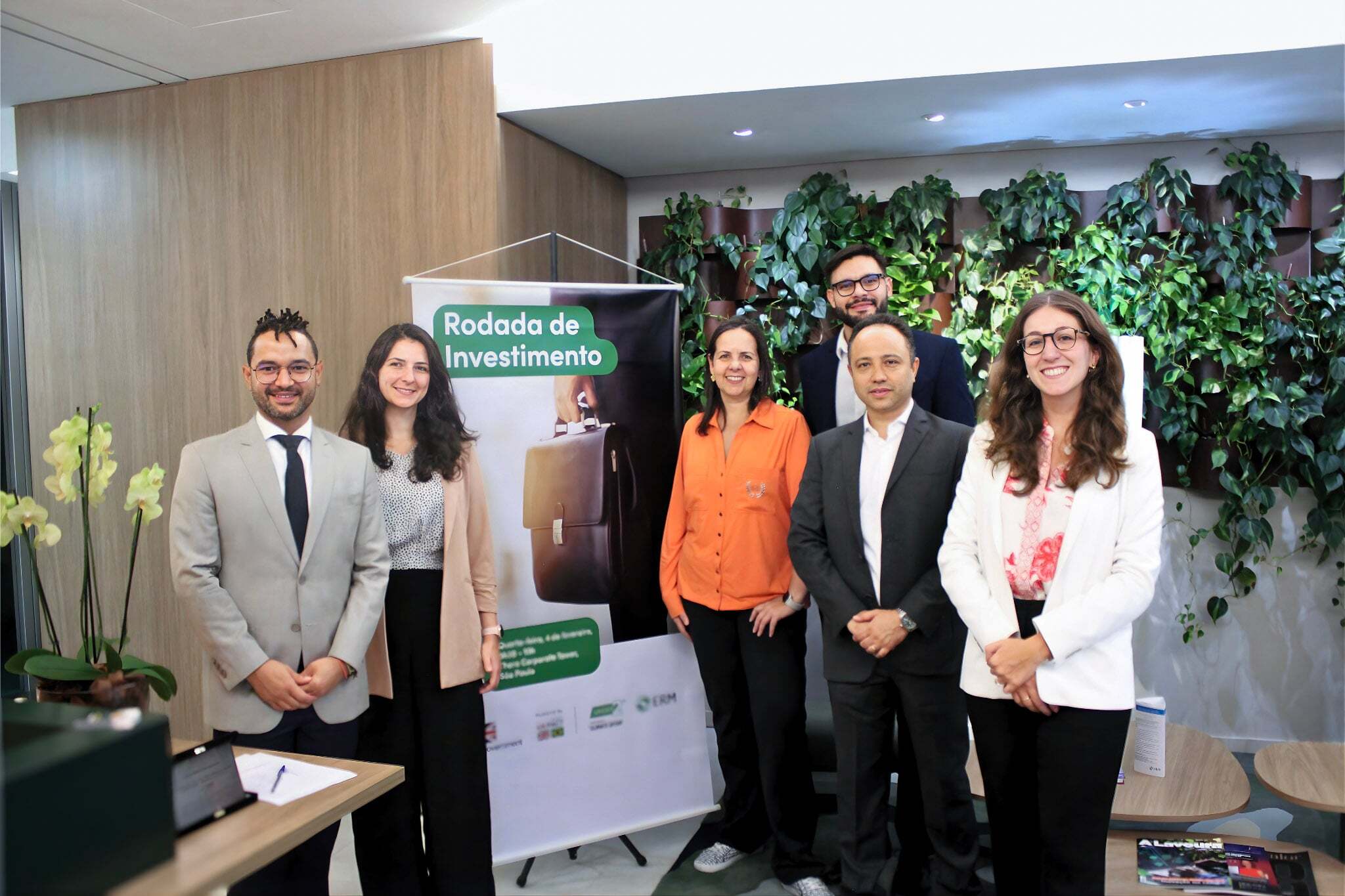
In February 2026, an Investment Roundtable in São Paulo showed a practical way to close the gap between climate ambition and real investment.
Working with three Brazilian states—Mato Grosso, Pernambuco, and São Paulo, nine concepts were developed and presented to more than 24 financial institutions. These included multilateral and national development banks, subnational development agencies, commercial banks, and ESG private investors.
Together, they engaged with a pipeline worth over US$1.4 billion (R$7.4 billion).
This wasn’t just a promising discussion between key economic players. It led to real momentum and negotiations between states and financiers to secure real climate finance.
The success of the roundtable is no surprise. Together, the three states have a highly diversified economy and a combined GDP of US$727 billion (R$3.7 trillion) larger than entire countries such as Belgium, Denmark or Sweden.
The climate projects came from the initiative Mobilising Green Investment for Brazilian States, led by the Under2 Coalition and supported by UK PACT in partnership with ERM.
The goal was simple but the successful results are refreshing news – work with three ambitious states to turn good climate ideas into bankable projects—projects that attract investment, deliver socioenvironmental co-benefits and can survive political change.
The result is a pipeline that is as climate and financially strong as it is diverse. It also highlights the major and often overlooked opportunity of working with states to advance climate implementation at scale.
Ambition is rising - but is finance keeping up?
While national climate targets and green economy strategies in Brazil and other countries are becoming more ambitious, investment is not flowing at the speed or scale needed. Many climate priorities remain stuck at the policy level, well-defined, well-meaning, but extremely underfunded.
Translating national ambition into investable projects requires:
- local knowledge and participation
- coordination across sectors
- institutions that can structure deals
and deals that investors actually understand and engage with
This is where things often stall. With extreme weather events on the rise, and communities and entire local economies bearing the brunt of climate change harsh realities, stalling is no longer an option.
The missing piece: Why states, why now
State governments sit at the intersection of national policy and local delivery. They control key sectors; land use, infrastructure, energy planning and are close enough to local realities to design workable and scalable solutions. National governments may set the direction but it’s states that make it happen – moving the needle along from policy to impact.
The experience from Mato Grosso, Pernambuco, and São Paulo shows that states are not just implementers, they are the missing link between ambition and investment. The result of this project demonstrates the enormous opportunity to work with states both for climate and financial aspects.
Working with states: The big climate investment opportunity ahead
States, regions and provinces vary greatly, but one thing connects them all: they hold key regulatory powers, and untapped potential to develop climate projects that will bring commitments and strategies from paper to real action.
Working with states is the way forward for accelerating the transition from climate ambition to investment-ready – bankable – solutions. Here’s why:

States hold key financial powers and can attract investment at scale
States have the authority, resources, and reach to develop large projects.
States possess the institutional reach and financial capacity to structure and implement climate initiatives, while having the potential to mobilise finance at scale. Unlike cities, which often face limitations such as capacity, budget and project ticket sizes, state governments can aggregate smaller projects, transforming fragmented local needs into coordinated investment pipelines.
Four projects developed through the initiative illustrate this dynamic. In São Paulo, SP+ Resilient was designed as a platform to channel climate finance toward municipalities across the state. This will speed up the implementation of urban adaptation and resilience projects, reducing transaction costs for investors while ensuring that -often underfunded- smaller and poorer cities are not excluded but prioritised. In Pernambuco, the Restoration of Sandy Beaches initiative proposes nature-based solutions to address coastal erosion along 55 kilometres of coastline in six municipalities, combining ecosystem restoration with the protection of tourism infrastructure and local economic activity. Still in the state of Pernambuco, the Transmission Infrastructure Expansion (EIT-PE) project aims to strengthen the state’s electricity transmission network to unlock renewable generation potential and support the development of low-carbon industries in the Northeastern region of Brazil. This also supports the low carbon development of the most vulnerable regions outside metropolitan areas and large cities. In Mato Grosso, the Cultiva Clima programme focuses on restoring degraded pastures and forests across the Amazon and Cerrado while strengthening the financial capacity of small farmers through sustainable production systems.

States move faster while staying closer to communities and key stakeholders
State governments are closer to local stakeholders—businesses, and communities.
Compared with their national counterparts, state-level governance often allows a more direct collaboration between government agencies, technical institutions and sectoral actors. This means that climate initiatives can reflect local economic and social structures better, while also moving much faster in turning ideas into implementation.
In São Paulo, the Jacutinga Trails initiative builds on years of engagement with small farmers to restore degraded parts of the Atlantic Forest by strengthening the juçara berry value chain. The project combines agroforestry production with forest restoration and biodiversity gains, increasing carbon storage while generating income for rural communities. In Pernambuco, the Biodiesel from Waste Oils and Fats initiative proposes converting agricultural and food-processing residues into biodiesel. This will reduce emissions by creating a regional bioenergy industry based on materials that are currently treated as waste, while also generating green jobs. In Mato Grosso, the Sustainable Pantanal Farm (FPS) focuses on promoting sustainable livestock production in the Pantanal biome through the adoption of scientific indicators and technical assistance to rural properties. By linking environmental monitoring with improved practices, the initiative seeks to conserve the biome and maintain economic productivity while reducing fire hazards and improving climate resilience for biodiversity and local livelihoods.

States build the system that make strategic projects possible
Beyond individual projects, states can also build the institutional infrastructure required to unlock resources for smaller and more local projects.
In São Paulo, the Environmental Assets Platform (PAA-SP) integrates territorial planning, environmental data and carbon market mechanisms to structure restoration projects and facilitate their access to climate finance. In Mato Grosso, the Botanical Garden & Herbarium aims at strengthening scientific and operational capacity for ecological restoration by supporting biodiversity research, native species conservation and seedling production for restoration programmes.
What next?
The project in Brazil shows that states are not only implementers of national climate policy, but also strategic platforms for designing climate strategies and structuring investment-ready, bankable solutions. This potential has been already reflected in the market engagement: out of the nine concept notes presented in the Investment Round in February, seven are currently in bilateral discussions with potential financiers.
More broadly, the results highlight the scalability of this approach. If a pilot initiative working with only three states was able to generate a US$ 1.4 billion pipeline of climate investment opportunities, the opportunity for expanding this model across Brazil and to other regions globally is enormous.
We no longer have a lack of ambition issue, or a lack of knowledge to make investable projects – both have excelled significantly. We have a climate finance issue, but we are closing the gap. This is round one with many rounds to follow.
To turn climate ambition into action, states are the missing piece of the puzzle.