




1) In the US, companies and states will keep moving the EV transition
If our latest US Leaders’ Summit is anything to go by, companies and states in the US remain driven to deliver the transition to cleaner, smarter road transport; they know it’s in their own long-term interest to do so.
But how can key players keep driving change without support at the national level?
In Washington DC, we brought together an exclusive roundtable where members of our EV100 network joined policy experts for a candid conversation about the state of the EV transition.
What quickly emerged during these conversations was a unanimous agreement that collaboration will be critical to a fast, affordable EV transition.
Fleets in the process of rapid electrification need to seek other key actors in the space – whether it’s around policy advocacy, project-specific partnerships, or joint engagement with utilities and utility regulators. Many highlighted the I10 corridor project led by Smart Freight Center as an example of a successful project-specific partnership. Through this project, companies will trial long-haul heavy-duty battery-electric vehicle operations between California and Texas.
A key challenge? The grid.
This is a huge bottleneck for building out charging for EVs, especially for medium- and heavy-duty vehicles. Delivering additional power capacity to sites where MHDVs need to charge is a burdensome process. The structural and regulatory environment for utilities doesn’t facilitate the massive load growth we expect from transportation electrification, and increased electricity demand for this is taking place alongside massive increases from other sectors.
As US companies and states reorientate themselves in an increasingly uncertain environment, China steams ahead (see below) – and those in the room agreed that the impact is likely to be huge.
The US federal government is currently rewriting fuel economy and emission standards which had just begun to provide regulatory certainty for manufacturers. At the same time, Congress is trying to remove state authority to mandate ZEV sales. And charging investments remain behind.
All of this is happening in the context of a rapidly evolving trade landscape.
But our members, and other key fleets, remain committed to rolling out EVs. This demand signal is a critical steadying force in the otherwise chaotic market.
If the US doesn’t invest heavily in its own domestic EV manufacturing – and incentivise the auto sector to get fully behind a decarbonised road transport future – it will see its role reduced in a global market dominated by Chinese EVs.
One unexpected upside to this, according to fleets and policy experts that joined us: it may change the politics of investments in domestic EV supply. As one panellist said: this time, automakers know they cannot go back to just making petrol and diesel cars – unless they want the US to be an importer of Chinese EV. We hope that this dynamic gives the EV tax credit in the US a greater shot of surviving.
How can we move US forward? Climate Group’s Adam Lake recaps the US Leaders’ Forum.
Next up in our series of agenda-setting events: the EV100 India Conclave, in New Delhi. On 15 May, we're convening leaders in the transport sector for faster EV adoption in India. It’s a space for collaboration, exchanging insights and accessing new knowledge to drive meaningful action towards a cleaner transport future.
Find out more ,
2) Minimum pricing for Chinese EVs could replace EU tariffs – in a win over hybrids
Back in 2017, when EV100 was founded and EVs had market share of just 1%, plug-in hybrids (PHEVs) were a critical bridging technology.
In 2025, that’s no longer the case. Some PHEV models emit more CO2 than advertised when tested on the road, according to the tests by Graz University of Technology, and research by the ICCT indicates that PHEVs used as private vehicles are only driven using the electric battery 45%-49% of the time. For company PHEVS that figure is even lower: only 11%-15%.
Yet, imports of Chinese PHEVs into the EU have risen by an incredible 892% across January and February, according to customs data cited by EV Magazine.
What’s going on?
PHEVs are currently exempt from the tariffs the EU placed on Chinese EV imports last year. (Tariffs are meant to protect the European car industry from fierce Chinese competition amid concerns about unfair state subsidies. They range from 7.8% to 35.3%, depending on the manufacturer and their cooperation with the EU's investigation.)
As the EU steps up efforts to tackle emissions from the transport sector, it’s essential to focus on true zero emission solutions, such as battery-electric vehicles (BEVs). An increase in the number of PHEVs on the road will undermine not support the shift to zero emission road transport.
That’s why it’s welcome news that the EU and China have agreed to look into an alternative to tariffs: setting minimum prices for Chinese-made electric vehicles instead.
This could be a game-changer. Minimum pricing could stop Chinese EVs from undercutting EU manufacturers in the same way as tariffs are designed to do – while providing a much more stable and predictable trading environment for both EU and Chinese automakers.
The welcome side effect: an end to the unfair advantage currently enjoyed by PHEVs, an outdated technology that has no place in the EV transition going forward.
Following consultation with our members, EV100 is changing how PHEVs are regarded within our membership commitment. More details to follow when we publicly relaunch our membership offer in June.
3) The battery battle is on – but will the grids keep up?
Last month, BYD sent a sent a clear signal to the global battery industry with a bold technological leap: a new charging system capable of delivering up to 470 km of range in just five minutes. Days later, CATL unveiled an upgraded Shenxing battery cell that delivers 520 km in the same time frame. The global race between top EV and battery makers is accelerating at unprecedented speed, delivering longer ranges and faster charging speeds with improved affordability.
If these claims prove viable at scale, they place Chinese manufacturers well ahead of their Western counterparts.
For comparison: Tesla EVs currently take 15 minutes to charge up to 320km in added range; the latest from Mercedes-Benz, an all-electric CLA compact sedan, charges within 10 minutes (for up to 325km), when using a fast-charging station.
Amid rising geopolitical tensions, there are questions as to how fast China’s turbochargers can bring their technology to costumers outside of China.
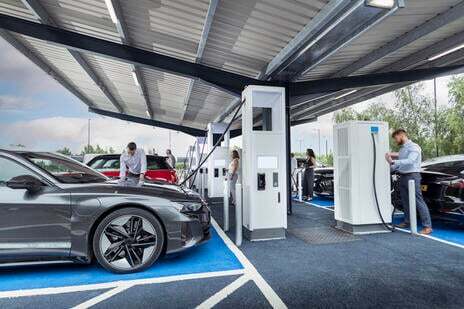
But there’s a wider concern: charging infrastructure.
While battery innovation is moving at breakneck speed, the development of charging infrastructure is not. Without parallel upgrades to power grids, charging stations, and energy storage systems, even the most advanced batteries may fall short of their potential. To truly unlock the benefits of ultra-fast charging, grid infrastructure needs to evolve just as quickly
Only then will fleets and consumers be able to take full advantage of advances in battery technology and charging time.
Ensuring that the grid is capable of supporting the EV transition is a key priority for the Climate Group Transport team.
At Climate Week NYC this year, we will be exploring the role of smart charging, two-way charging, and demand-side management in balancing grid loads. And we’ll explore how utilities, regulators, and businesses can collaborate to accelerate necessary grid upgrades.