




1) A strong corporate demand signal will be even more important to carry the transition through uncertain political times
“There has never been a better time to electrify commercial fleets than today.”
The statement, by Josh Green, Founder and CEO of EV100 member Inspiration Mobility, grabbed the audience at this year’s Climate Week NYC, where Transport had its biggest presence yet, with 20 events across five days, more than 100 speakers, and a roster of new insights to inform our work from here.
For fleets, “it's not a matter of ‘if EVs work for me,’ but a matter of ‘where EVs work for me’,” said Green in our panel Charging ahead: driving the global EV transition in a shifting political landscape.
“Nothing is stopping most companies right now but internal will.”
The world-leading companies of our EV100 network have shown this internal will – in courageous, inspiring ways – for years. Many of them are now more than halfway towards their stated aim of 100% electric fleets.
With companies in the lead, the global EV transition is picking up speed in markets around the world. Countries like Vietnam (where 35% new vehicle sales are now electric), Ethiopia and Costa Rica are quickly catching up with Europe on EV sales shares. Thailand and Uruguay are close to outperforming the US. Brazil has surpassed Japan.
Our panelists in New York agreed: the arguments and the data are all with us; there’s no question where we’re headed. Road transport will be electric.
What remains in the way? To really drive down transportation emissions, we need the costs of EVs – across weight classes – to come down. Upfront affordability is key.
That’s why, amid an uncertain policy landscape – in countries like the US, as well as the EU, and elsewhere –, the demand signal from companies, like our 120+ EV100 members, is critical. To build enough vehicles to bring costs down, manufacturers need confidence that EV customers are out there, regardless of the durability of incentives.
By becoming EV100 members, businesses are sending this vital message to the world’s car, van and truck manufacturers, who are responsive to their customers. This leadership and focus, we agreed in New York, will help cut through ongoing political polarisation and policy uncertainty, in the US and elsewhere.
Inspiration Mobility is our latest EV100 member. Find out how they are accelerating the EV transition to decarbonize commercial transportation at scale.
Discover EV100 ,Charging ahead: driving the global EV transition in a shifting political landscape
2) In markets around the world, the grid will need significant upgrades to be ready for the next phase of the EV transition
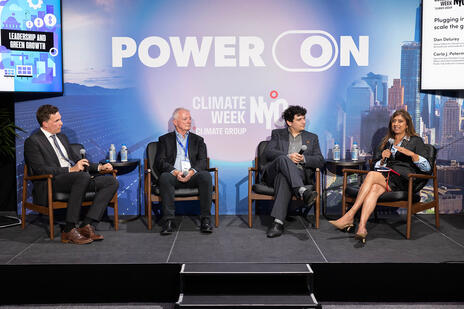
A second session at Climate Group’s flagship The Hub Live tackled one of trickiest issues for the shift to cleaner road transport.
“The EV transition is happening across vehicle segments,” said Dominic Phinn, our Head of Transport. “It's accelerating, it’s global – but what are the implications for the grid?”
It’s estimated we need 100 terawatts of increased capacity to meet energy demand of EVs alone. Even a mini charging depot can use as much energy as a small sports stadium.
“It's a huge challenge.”
Grid upgrades are complex – and what’s required can differ, often considerably, between markets. But the basic questions are the same. How can we optimize the grid so it can handle vastly increased demand from EVs, alongside data centers and other high-demand applications?
How can we get more clean energy onto our grids faster? And how can EV charging depots be connected to the grid without long waiting times?
“Building capacity is the biggest issue we see right now,” said Sujata Sullivan, CCO at Lovink. But as technologies keep advancing, “we’re going to see a lot more collaboration.”
Across The Hub Live program, there was strong consensus around this: no company can achieve the vital transitions we need alone. Working together, across sectors and perceived divides, is key.
The panel highlighted a particularly inspiring collaboration, between two EV100 members, Prologis and Maersk, who created a heavy-duty charging hub in California – powered by a microgrid. (Read more about this our #EVLearnings series.) For the project, built in record time, the two companies re-thought charging infrastructure fundamentally.
“People don’t realize these things are already happening,” said Sullivan.
Where next? According to Sam Hersh, North America E-Mobility Solution Lead at EV100 member Arcadis, it's all about “finding the small projects that can catalyze new technologies in a commercially viable way.”
This spirit of innovation and solution-finding runs through the EV100 network, and the grid is a thematic priority for us. We're looking forward to sharing new insights with our members as the network keeps driving us forward.
Read the Climate Week NYC wrap-up ,Plugging into the future: how to scale the grid for EV adoption
3) Meanwhile in the EU, a series of major decisions will determine where Europe’s EV transition is going next
The good news: On 7 October, the European Parliament agreed to extend the power of Member States to exempt zero-emission heavy duty vehicles from road tolls.
Subject to final Council approval, the Eurovignette Directive will be in place until 30 June 2031.
It’s a welcome move that will lower operating costs for fleets investing in the transition. If Member States make full use of their exemption powers, it’s likely to accelerate the shift to zero-emission heavy transport.
Meanwhile, larger regulatory debates are intensifying across the EU. Three pieces are critical:
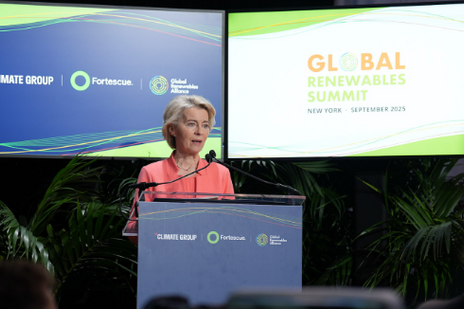
- The revision of the 2035 CO₂ standards for cars and vans. In her State of the Union address, Commission President Ursula von der Leyen, who joined us at Climate Week NYC (pictured), called for “an E-car initiative - environmental, economical and European”. Her plea did little to quiet tensions between manufacturers seeking more flexibilities and NGOs and fleets pushing to hold the line on the 2035 zero-emission target. The revision is expected by the end of the year.
- The forthcoming Clean Corporate Vehicles proposal, also expected by end of year, could be a game-changer for corporate fleet electrification, but the devil will be in the detail. EV100 and several individual members have called on the Commission to ensure binding zero-emission fleet targets – alongside a boost to the wider EV ecosystem, including reliable vehicle supply, improved charging infrastructure, an upgraded grid, and incentives – and to include large shippers and transport buyers in the scope of the legislation.
Beyond vehicles, infrastructure remains central. The Commission’s upcoming Grids Package and Electrification Action Plan can tackle major barriers to charging infrastructure, from grid connection delays to access to affordable clean power. We have a new paper coming out explaining how.
As Europe edges closer to 2030, the signal from Brussels is clear: the road to zero-emission transport is being built.
But the route will depend on decisive political will in the coming months.
EV100 members add their voices