




Electric trucks can be a financially smart move for businesses. While upfront costs are significantly higher (today), electric models offer lower fuel and maintenance expenses over time than fossil fuel-based trucks. The Total Cost of Ownership (TCO) is a useful measure to know about electric truck cost effectiveness, which this blog explores.
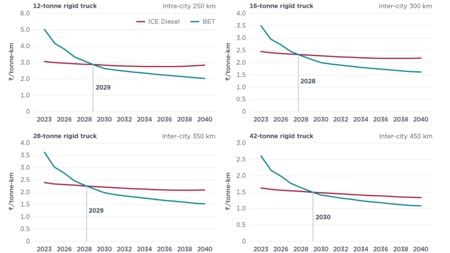
According to the latest report on TCO comparisons of Medium and Heavy-Duty Trucks by ICCT, the upfront costs of electric medium and heavy duty trucks (eMHDTs) were 4–6 times higher than diesel trucks in 2023. Their upfront costs are projected to fall from 4-6 times to 1.2–1.4 times by 2040 for 12-tonne, 16-tonne, and 28-tonne trucks. For 42 tonnes it is expected to reach up to two times ICE counterparts. A change is expected in the next five years with a projected 65% drop in battery costs between 2023 and 2040, along with improved fuel economy helping eMHDTs reach TCO parity with diesel trucks by 2040. As per the Comprehensive Guide to Financing the Zero-Emission Trucking Transition in India (RMI and CoEZET, 2024), the current TCO of eMHDTs is 20%–30% higher than that of diesel trucks.
Figure 1: TCO comparisons for ICE diesel and e-MHDT Trucks by ICCT
Source: TCO comparisons of Medium and Heavy-Duty Trucks by ICCT
Government policy support can reduce the cost of eMHDTs faster. Direct financial incentives such as purchase subsidies, interest rate subventions, road tax and toll waivers, along with non-fiscal incentives like gross vehicle weight relaxation are enabling TCO parity.
These policy measures are making the TCO viable for eMHDTs in the 12,16 and 28 tonne segments. As per a report by ICCT on TCO comparison of MHDT trucks, the TCO gap is nearly closed for 42-tonne trucks. By 2030, eMHDTs are expected to have a lower TCO than diesel trucks for distances between 200–700 kms. Heavy-duty fast chargers which are compatible for eMHDTs along highways and major freight corridors will support a robust charging infrastructure network, maximising public charging and reducing the cost of charging resulting in TCO savings.
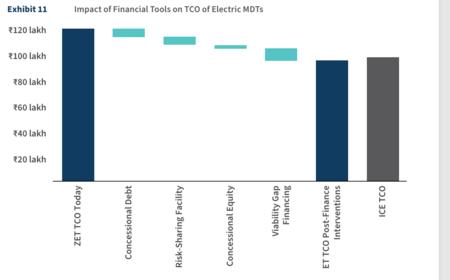
By employing financial tools such as concessional debt, equity, guarantees and viability gap financing, Battery Electric Trucks (BETs) can in fact have 3% more TCO than diesel vehicles.
Figure 2: Policy measures in terms of enabling the viability of TCO
The reason why the upfront cost of electric trucks is higher than their diesel counterparts is the battery, which is almost 50% of the total vehicle cost. But, with reduced expenditure on fuel and maintenance, the overall savings that electric trucks provide compensation for the initial investments.
According to a joint report by NITI Aayog and RMI India, eMHDTs can reduce operational costs by 30% during their lifetime. For owners, it is important to consider the strategic move to cut long term costs and future proof operations against fluctuating fuel prices. As the market evolves, so will battery technology and battery prices have already reduced over the past few years.
Instead of focusing on upfront costs, it is important to take the whole-of-life operating costs including maintenance and fuel usage. In India, diesel costs approximately ₹80-90 per litre and electricity is around ₹6-10 per kWh. The cost benefits of switching to eMHDTs are notable. The potential savings on fuel range are between 30% and 50%, depending on specific usage and electricity rates. Electric trucks also incur lower maintenance costs compared to diesel trucks due to fewer parts and no need for oil change.
Regenerative braking - a feature available in electric trucks which enhances vehicle efficiency by converting kinetic energy to electrical energy during braking - also complements vehicle run. With development in charging infrastructure and battery technology, the convenience and accessibility of electric trucks are bound to increase.
Curious to know more? Take a look at our work on electric trucks here.